
Tucson Speedway – A Thrilling Desert Short Track
Introduction
Tucson Speedway is a storied short track that has kept motorsports thriving in the Arizona desert for decades. Established in 1968, it originally opened as Raven Speedway, a dusty clay oval built by local racing enthusiasts. Over the years, the track evolved through several names and upgrades – at one point known as Corona Speedway, and later as Tucson Raceway Park after a major 1993 renovation that saw it paved and reconfigured. Located at the Pima County Fairgrounds about 20 miles southeast of downtown Tucson, Arizona, this facility is one of only a few paved ovals in the state. It has become a centerpiece of regional racing, hosting everything from weekly NASCAR-sanctioned stock car events to special attractions like monster truck shows and demolition derbies. The Speedway joined the NASCAR Home Tracks program in 2014, cementing its status as a hub for stock car racing in the Southwest. With its rich history – including brushes with NASCAR’s elite – and a passionate local following, Tucson Speedway offers a unique blend of hometown charm and national-level racing excitement.
Track Specifications
Track Size & Surface: Tucson Speedway is a 3/8-mile (0.375 mile, approximately 0.6 km) oval. Once a dirt track in its early years, it was converted to a paved asphalt surface in the early 1990s. The asphalt is well-maintained, providing a smooth but grippy racing surface that drivers praise for its consistency. The track’s banking is progressive, ranging from about 3 degrees on the inside to 9 degrees near the outside wall. This variable banking allows multiple racing lines through the turns, encouraging the side-by-side battles that short track fans love.
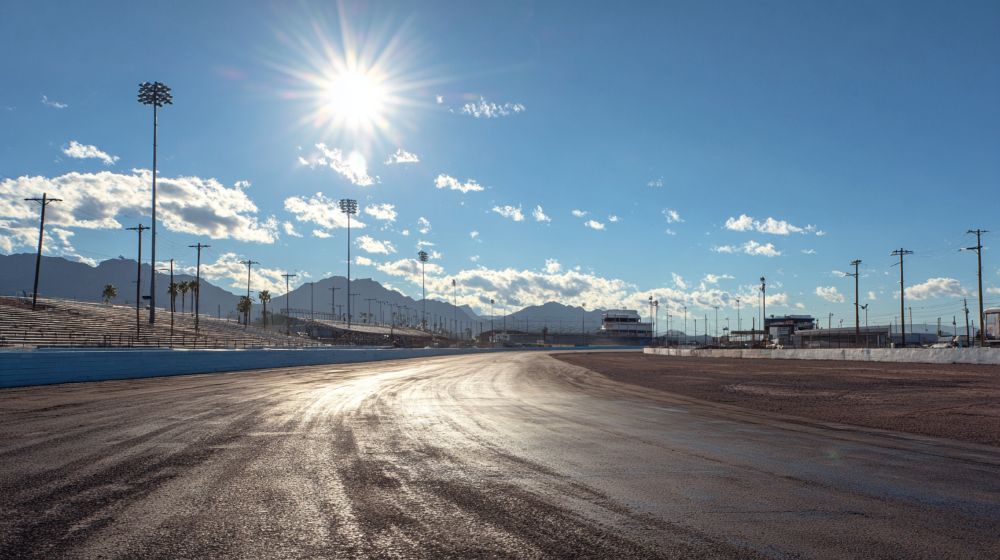
Layout & Features: The oval’s shape is relatively symmetrical, with tight turns and straightaways that demand both handling and horsepower. A lap takes only around 15 seconds in a high-powered stock car – blink and you might miss the leader flying by! The current track configuration (shortened from a larger half-mile layout decades ago) ensures close-quarters racing and quick lap times. Tucson’s high desert elevation (around 3,000 feet above sea level) and dry climate mean the track surface doesn’t get overly slick from humidity, and events can run nearly year-round. In fact, the racing season typically stretches from February through November, taking advantage of southern Arizona’s mild winters. The facility features a robust lighting system for night races, which are common in the hot summer months. One notable track record was set by a Super Late Model turning a sub-15 second lap, showcasing speeds approaching 90–100 mph on this short oval – impressive for a track of this length.
Capacity: The Speedway can accommodate roughly 6,000 to 6,500 spectators in its main grandstands. The seating is stadium-style bleachers along the front straightaway, offering a full view of the oval. Despite its relatively small size, the track has a big-time feel when packed with cheering fans on a Saturday night. The surrounding pit area is expansive (the pit lane is outside the oval’s back stretch), and there’s ample space in the infield for safety crews and event operations. Overall, Tucson Speedway’s specifications make it a quintessential short track: small in length, but huge in action.
Famous Events and Races
Over the years, Tucson Speedway has been the stage for numerous iconic races and pivotal moments in racing history:
- NASCAR Winter Heat Series (1990s): In the mid-1990s, the track gained national fame as host of NASCAR’s televised Winter Heat series. During NASCAR’s offseason (December and January), Tucson Raceway Park (as it was then known) held special events that were broadcast on TNN and ESPN2, giving fans across the country a racing fix in winter. These races featured rising stars and regional heroes battling it out on the 3/8-mile oval. The Winter Heat Series proved to be a launching pad for future NASCAR champions and stars. Drivers like Kurt Busch, Kevin Harvick, Greg Biffle, Matt Crafton, and Ron Hornaday Jr. all cut their teeth in Winter Heat events at Tucson. Kurt Busch later reminisced that back in the ’90s the “whole country was glued to their TVs” watching young drivers slug it out in Tucson’s winter races – a testament to how influential those events were. The series (which ran from 1994–1999) not only entertained fans but also put Tucson on the national racing map, as viewers witnessed the desert short track produce wheel-to-wheel action and future stars.
- NASCAR Craftsman Truck Series Races: Tucson Speedway holds the distinction of hosting some of the very first NASCAR Craftsman Truck Series races. When the Truck Series launched in 1995, Tucson was the site of the second-ever event on the inaugural schedule. That race, the Racing Champions 200 in April 1995, was won by Ron Hornaday Jr., a driver who had already found success at Tucson. The track went on to host Truck Series races in 1996 and 1997 as well (under titles like the NAPA 200), bringing top NASCAR teams to town. Fans packed the stands to see full-size NASCAR trucks thundering around the short oval. Notably, in 1996 the great Mike Skinner claimed victory at Tucson, and in 1997 Hornaday returned to win again. Those races are remembered for their intense short-track battles – an early showcase of the Truck Series’ door-to-door excitement. Hosting NASCAR national series events was a big honor for the facility and gave local fans a chance to see big-name drivers and teams up close.
- NASCAR West Series and Southwest Tour: Beyond the Truck races, Tucson has hosted numerous events in NASCAR’s regional touring series. The NASCAR Southwest Tour (a late model stock car series) visited often in the 1990s and early 2000s. In fact, a young Kevin Harvick won a Southwest Tour race at Tucson in 1995, years before his NASCAR Cup Series stardom. Kurt Busch also grabbed a victory in a Southwest Tour event at Tucson (in 1999), cementing his local legend status before moving up the ranks. The NASCAR K&N Pro Series West (now known as the ARCA Menards Series West) has additionally held races at Tucson Speedway, including modern-era events. In the 2015–2019 period, Tucson hosted several West Series races, often as twin 100-lap features. Fans saw emerging talents like Noah Gragson (2015 winner), Ryan Partridge, Chris Eggleston, and Derek Kraus (2018–2019 winner of back-to-back twin races) take checkered flags in Tucson. These regional series events brought professional-level competition to the local oval and often drew teams from all over the West Coast. They also produced some thrilling finishes and added new chapters to the track’s history.
- Chilly Willy 150: In the realm of local short-track racing, Tucson Speedway’s flagship annual event is undoubtedly the Chilly Willy 150. This is a mid-winter Super Late Model race (held in late January or early February) that serves as the season kickoff. Despite the “chilly” name, the competition is red-hot. The Chilly Willy 150 attracts top late model drivers from across the U.S. and even Canada, all competing for a prestigious win to start the year. Since its inception in 2014, the race has quickly become a fan favorite and a point of pride for the track. Past winners include notable short-track aces like Dustin Ash, Tayler Riddle, Preston Peltier, and Christian McGhee, among others. The event often features time trials, qualifying races, and then the 150-lap main event, testing teams’ endurance and setups on Tucson’s 3/8-mile. The atmosphere is festive – it’s not just a race but a celebration of the new racing season, with fans braving the cool January desert nights to see top-tier short track racing. Victory in the Chilly Willy is highly coveted, and the race has produced dramatic moments, from last-lap passes to young underdog drivers upsetting veteran favorites.
- “Turkey Shoot” and Other Local Classics: To bookend the season, Tucson Speedway typically hosts a Thanksgiving weekend event known as the Turkey Shoot or “King of the Hill.” This year-end showdown brings various divisions together for one more shot at glory before the winter break. It often features fun formats or special bonuses, giving drivers and fans a final adrenaline rush for the year. Throughout the season, the track also schedules special nights like memorial races, demolition derby evenings, and stunt shows. Monster truck rallies have been held at the facility as well, utilizing the infield for car-crushing entertainment that complements the racing calendar. These events diversify the schedule and draw different crowds, all while utilizing the track’s versatile venue.
Across all these events, Tucson Speedway has consistently produced memorable racing and storylines. From being the cradle of future NASCAR champions in the Winter Heat days, to providing local Arizona racers a stage to shine under the lights, the track’s legacy is filled with checkered flags and cheers. Long-time fans can recall historic moments like photo-finish victories, track record runs, and even the occasional on-track rivalry flare-up. It’s all part of what makes Tucson Speedway an iconic stop on the racing map.
Vendors and Companies Supporting Track Operations
It takes a whole network of dedicated companies and vendors to keep a racetrack running smoothly, and Tucson Speedway is a prime example of a community-supported operation. Everything from the asphalt under the cars to the fuel in their tanks is the result of partnerships with specialized businesses. Here are some of the key support systems and vendors behind the scenes:
Track Maintenance and Resurfacing: Maintaining a high-quality racing surface in the desert is no small task. Over the years, the speedway has worked with paving and construction companies to lay down and refresh its asphalt. The original paving back in 1993 was done under the guidance of the International Speedway Corporation (ISC), which brought in professional track builders. More recently, local contractors have been involved in patching cracks, sealing the surface, and ensuring the oval remains smooth and fast. The dry climate means the track doesn’t get waterlogged, but the intense sun can wear on the pavement, so regular maintenance is crucial. Tucson Speedway’s management invests in resurfacing when needed and even minor details like painting the walls and restriping the racing line. It’s often said that the track crew practically “babies” the surface – they want racers to have the best possible grip. Before each race event, you might see crews sweeping the track, blowing off desert dust, or applying traction compound in the corners for certain big races. Local heavy equipment suppliers (such as Sonsray Machinery) play a role by providing machinery like sweepers or asphalt rollers when the track undergoes improvements. Essentially, the track’s very foundation is supported by companies that specialize in pavement and facility upkeep.
Tire and Parts Suppliers: Short-track racing devours tires, and Tucson Speedway has an integrated system to supply teams with the rubber they need. A key partner is the tire distributor who provides the spec racing tires (usually Hoosier brand slicks for the asphalt divisions). In fact, the track has an on-site tire shed where teams can purchase their allotted tires on race day. Southern Tire Mart, one of the track’s sponsors, supports the operation by helping manage tire inventory and distribution – they are a well-known tire service company and lend their expertise to ensure the racers have fresh tires mounted safely. Additionally, local auto parts and speed shops are deeply involved. UPR Racing Supply (a sponsor with a regional presence) often sets up at the track or is the go-to source for racers to get parts, safety gear, and specialized equipment. Another sponsor, Interstate Batteries, ensures that teams and track officials have reliable batteries for race cars, pit equipment, and the track’s own vehicles. Even O’Reilly Auto Parts and local automotive retailers support the track – whether through sponsorship or by staying open late to help a racer grab a last-minute part on a Saturday afternoon. The result is a network of parts suppliers ready to keep the competition rolling.
Fuel and Fluids: High-octane racing fuel is the lifeblood of any track, and Tucson Speedway is no exception. The track provides racing fuel (typically 110-octane leaded fuel for the late models and other performance classes) right on site. Large fuel drums and a pumping station are located in the pit area. Torco, a performance fuels and lubricants brand, is a notable sponsor and likely the official fuel supplier – their products ensure the race cars get consistent, quality fuel for maximum performance. In addition, oil and fluid suppliers partner with the track to recycle used oil and provide fresh fluids. The speedway has big drums for teams to dump used motor oil, which is then picked up by environmental service companies. This not only keeps the facility clean but also demonstrates eco-conscious operation (they recycle hundreds of gallons of oil and even spent tires each year). From engine coolant to brake fluid, the racing operations rely on these suppliers to keep machines in top shape, and Tucson’s local auto shops are often ready to step in. For example, Merle’s Automotive and Parts Authority (both supporters of the track) are known in the region for providing everything from performance additives to mundane nuts and bolts that teams might need in a pinch.
Safety Equipment and Barriers: Safety is paramount at a motorsports venue, and maintaining things like guardrails, fencing, and protective barriers involves specialized vendors. Tucson Speedway’s perimeter is lined with a concrete wall and catch fencing to protect spectators. Over time, these barriers need repair or upgrades. The track works with companies that supply safety barrier technology – this could be as simple as sourcing concrete “jersey” barriers from construction suppliers, or as advanced as consulting with experts on energy-absorbing wall inserts (while Tucson doesn’t have NASCAR’s steel SAFER barriers due to cost, they employ thick concrete and rubber tire buffers in key impact zones). A Phoenix-based company that recycles tires, CRM, contributed a huge number of rubber chips that not only rejuvenated the children’s playground, but extra tire bales have been used as buffers in less critical impact areas. The fencing – vital for keeping debris off the stands – is maintained with the help of local fence contractors and welding shops, who can mend bent sections or reinforce posts after any incident. Additionally, the track’s lighting and electrical systems rely on local electrical companies, especially when expansions or repairs are needed (aiming massive light towers or wiring the scoring loop under the track requires expertise). Companies like Crown Electric or Hydraulic & Air Supply (both names seen among sponsors) often assist with infrastructure, whether it’s a hydraulic system for the track’s pit gate or the electrical components of the scoreboard. Every bolt and cable of the facility has some local business behind it.
Automotive Services and Local Shops: Perhaps the most visible support comes from the many local automotive service shops that are involved with the track. Stroll through the pits or look at the sponsor billboards, and you’ll see names of Tucson-area auto repair centers, body shops, and dealerships that keep this racing community running. For example, Jack Furrier Tire & Auto Care – a prominent tire and auto service chain in Tucson – is a longtime track supporter, offering everything from tire mounting services to sponsoring race events. Simmons Auto Repair, Aaron’s Auto Repair, and Friendly Automotive are other local garages that not only advertise at the track but often directly assist race teams with mechanical work. It’s common for a local engine builder or chassis specialist to have multiple cars at Tucson Speedway running their equipment; these specialists (some of whom might not be household names to the public) are crucial vendors for the racers. If a driver blows an engine, there’s likely a local machine shop ready to help rebuild it. If a car needs a quick welding fix, a local fabrication shop owner who also races might lend a hand. This tight-knit network means that on any given race night, you might find competitors borrowing parts or getting help from the same local suppliers – all in the spirit of keeping the show going.
Vehicle Auto Glass Services: Even in stock car racing, auto glass matters in Tucson– from the windshield in a hobby stock (often a special polycarbonate “Lexan” windshield) to the glass in tow vehicles and support trucks. Flying debris and the rigors of racing can result in cracked windshields or windows, and Tucson’s racing scene is supported by auto glass specialists as well. While race cars themselves usually use shatter-resistant plastic instead of street glass, the haulers and official vehicles certainly rely on glass. Local Tucson auto glass service companies like Dealer Auto Glass step up by providing quick windshield replacements and custom-fit lexan shields for the race cars. For instance, a racer who shatters a windshield in practice might call up a friendly local glass vendor who can cut a new polycarbonate windshield that afternoon. And for the track’s pace car or work trucks, having a partner that can fix a cracked windshield from a stray pebble is invaluable. By highlighting even this niche service, Tucson Speedway demonstrates that every aspect of running and racing is covered by a supportive business. (In fact, some fans have joked that if you need anything in Tucson – tires, an oil change, a paint job, or a new windshield – just head to the track and you’ll meet someone in that business!).
Specialized Support: Beyond the obvious, the track engages with various other specialized vendors. Fuel providers like the aforementioned Torco (and previously Sunoco race fuels) ensure a steady supply of high-grade fuel. Mechanical support comes not only from auto shops but also from heavy equipment mechanics (for example, maintaining the track’s water truck, grader, or generator – companies like WW Williams, a diesel and heavy equipment service firm, have sponsored events and likely help in this arena). Parts suppliers also include performance brands: it’s not uncommon to see a trailer selling safety gear (helmets, fire suits, harnesses) or chassis parts at big races – often those are regional racing supply companies that set up shop for the weekend. Additionally, technology vendors are part of operations: the electronic timing and scoring system uses transponders and software (supported by the MyRacePass system) – a high-tech company out of state provides that, but local IT support ensures the computers and internet run smoothly on race day. The track also coordinates with local media and advertising firms to promote events (the presence of companies like Cushman & Wakefield and PICOR – big real estate and marketing players – as sponsors suggests the broader business community sees value in supporting and getting exposure at the speedway).
In summary, Tucson Speedway’s success is truly a community effort. Around 90+ local and regional businesses support the track through sponsorship or services. They provide the materials, expertise, and funds needed to keep the facility in top shape and the events running safely. This synergy not only benefits the racers and fans but also stimulates the local economy – a lot of money flows to local vendors as part of the racing operations. It’s a virtuous circle: the track gives businesses exposure to fans, and those businesses in turn keep the track thriving. Whether it’s a major corporation like a tire company or a small-town welding shop helping fix a broken fence, Tucson Speedway’s network of vendors exemplifies the phrase “it takes a village to raise a racetrack.”

Community and Economic Impact
Tucson Speedway isn’t just a weekend entertainment venue – it’s an important contributor to the local community and economy of southern Arizona. The presence of the track has a ripple effect that goes far beyond the roar of engines on a Saturday night.
Economic Boost: Every race event brings a surge of economic activity. Fans traveling in from around the region (and even out of state for big races) spend money on hotel rooms, dine at local restaurants, buy gas, and shop in Tucson. Major events like the Chilly Willy 150 or a NASCAR regional race can attract teams and spectators who stay multiple nights. The partnership with nearby hotels (such as the Hilton Garden Inn) illustrates this synergy – the track helps fill hotel beds, and the hotels in turn often sponsor or offer deals to fans. Local restaurants and bars also see increased traffic after the races, as fans often grab a late bite or celebrate a victory in town. Even the Pima County Fairgrounds benefits, as track attendees sometimes cross over to other fairground events or come back for the annual fair. Studies have shown that grassroots motorsports facilities can bring in millions of dollars to their communities annually, and Tucson Speedway is no exception. The track’s own estimates indicate an annual attendance of around 50,000–60,000 spectators across all events, which translates into significant revenue for local businesses. On race days, it’s common to see nearby convenience stores and fast-food joints bustling with people in racing t-shirts – a sure sign that race fans are patronizing local establishments.
Employment and Business Opportunities: Tucson Speedway directly and indirectly supports many jobs. The track itself employs a range of people: ticket takers, concession workers, security personnel, announcers, track crew, cleaners, and administrative staff. On a busy race night, around 50 to 60 staff and volunteers might be working to make the event happen. Many of these are part-time or seasonal jobs, but they provide income to local residents and opportunities for young people to get work experience in a fun environment. Moreover, the racing teams spend money locally – buying parts, hiring local mechanics or welders for specialized work, and fueling up at local gas stations for their tow rigs. Some teams hire local help (such as weekend pit crew or tire specialists). The presence of the track has even spurred niche businesses – for instance, someone might start a racing graphics company or a small machine shop specifically catering to the cars racing at Tucson. The “racing economy” around the track includes engine builders, fabricators, and suppliers who have built client bases thanks to the weekly events. The track management also contracts local services for things like waste management (trash pickup after events), security (off-duty officers), and medical support (EMS crews). All of these represent dollars flowing into the local workforce.
Local Sponsorship and Advertising: The fact that nearly 100 local businesses sponsor Tucson Speedway (as mentioned earlier) indicates how the track serves as a community marketing hub. For many small businesses, advertising at the local track is an affordable and effective way to reach residents. In turn, those sponsorship dollars help the track improve facilities and prize payouts, fueling a cycle of growth. This partnership often extends to community givebacks – for example, a local car dealership sponsor might display a pace car at the track and also host a charity night in conjunction with the speedway. It’s not uncommon for the track to have promotions like “XYZ Auto Body Night” where a sponsor not only supports the purse for racers but also gives away something to fans (such as free T-shirts or a raffle prize), creating goodwill in the community. Community outreach initiatives frequently accompany these sponsorships. Tucson Speedway has been known to participate in charity drives – such as hosting a canned food drive or toy drive at the gate (fans bringing donations might get a discount on admission). The racing community is quite generous; drivers and fans often rally for causes like local hospitals or youth programs.
Education and Youth Engagement: The track also positively impacts youth in the area. With entry-level classes like Bandoleros (small scale race cars for kids as young as 8 or 9) and Legends cars for teenagers, Tucson Speedway offers a constructive, exciting outlet for young racing enthusiasts. Instead of street racing or other risky behaviors, young drivers can hone their skills in a controlled, safety-focused environment. Some local high schools and colleges have automotive programs or engineering clubs that come out to the track to learn about mechanics and racing technology. On occasion, the speedway has organized “Student Nights” where students get in free or at a discount, introducing a new generation to motorsports. By engaging youth, the track fosters a culture of responsibility, teamwork, and technical learning – kids working on a race team are essentially gaining mechanical skills and discipline that can serve them well in future careers.
Civic and Charity Partnerships: Tucson Speedway strives to be a good neighbor and actively works with civic organizations. For instance, the track partnered with the Pima County Department of Environmental Quality on that tire recycling initiative – turning old tires into playground material (as highlighted by track president John Lashley, who championed the environmentally friendly approach). The Boy Scouts have been involved in recycling at the track, helping collect cans and bottles on race nights as a fund-raiser and environmental effort. Additionally, the facility has hosted or supported events like car club gatherings, police and firefighter appreciation nights, and military veteran tributes. A common event is “First Responders Night” or “Military Appreciation Night” where those community heroes are honored (often with free admission or a salute on the track during opening ceremonies). These gestures build strong ties between the speedway and local community institutions.
Tourism and Regional Identity: The Speedway also contributes to Tucson’s identity and tourism appeal. Auto racing is a popular pastime, and having a NASCAR-sanctioned track is something Tucson can boast about. It’s part of the sports landscape of the region, alongside things like University of Arizona athletics and the rodeo. Motorsports fans traveling through Arizona often know Tucson Speedway and will plan a trip to coincide with a race night. The track is even listed in travel guides and “things to do in Tucson” for weekend entertainment. This kind of visibility puts Tucson on the national map for racing – especially during big events when media (like FloRacing or local TV news) cover the races. The recent revival and success of the Chilly Willy 150, for example, has drawn drivers and fans from far and wide, giving Tucson a little tourism boost during the normally quiet winter months. All these visitors contribute to the hospitality industry income and often return year after year, essentially becoming motorsports tourists loyal to Tucson.
In summary, Tucson Speedway is deeply woven into the fabric of the community. Economically, it generates revenue and jobs; socially, it provides a gathering place and pride for residents. It’s a place where a local business owner might entertain clients on a race night, or where families spend quality time together cheering their hometown heroes. For Southern Arizona, the speedway is more than just noise and fast cars – it’s a tradition that brings people together and pumps vitality into the local economy.
Insider Tips for Visitors
Planning a trip to Tucson Speedway? Whether you’re a first-time spectator or a seasoned regular, here are some insider tips to help you make the most of your visit:
Best Places to Watch: The grandstands offer good views everywhere, but arguably the high seats near the middle (around the start/finish line) are prime. From there, you can see both turns clearly and have a bird’s-eye perspective of pit road and victory lane. If you prefer to be closer to the action (and don’t mind possibly getting a little tire rubber speckle on you), sitting lower down toward Turn 1 puts you near the dramatic first-corner shuffles on restarts. Some fans also like the end of the grandstand toward Turn 4, where you can feel the rush as cars barrel out of the last turn and charge to the checkered flag. Keep in mind, Tucson Speedway does not have covered seating, so if you’re at a day event or an early evening event, consider positioning yourself with the sun at your back (typically, the sun will set behind Turn 3/4 side). Many veteran fans bring a seat cushion or even a small bleacher seat with a back – it’ll make the metal bleachers much more comfortable for a full night of racing.
Arrive Early: Gates usually open an hour or more before the first race (often around 5:00 PM for a 6:30 PM start, but check the schedule). Arriving early has its perks. Parking will be easier and closer to the entrance, you won’t feel rushed getting through the ticket line, and you’ll have time to explore. Early arrival means you can roam the midway, grab food before the lines get long, and find your preferred spot in the stands (general admission seating is first-come, first-served). Plus, you might catch some of the qualifying or practice laps, which is always interesting to watch as drivers dial in their cars. On special event nights, pre-race ceremonies might include driver introductions, autograph sessions, or other entertainment – another reason not to be late.
What to Bring (and Not to Bring): In the desert climate, even if the day is hot, evenings can cool off quickly. Dress in layers or have a light jacket or hoodie handy, especially if you’re attending in spring or fall. Sunscreen and a hat are wise for day events (and even the late afternoon sun can be strong). Ear protection is strongly recommended – the sound of roaring engines on a short track is part of the thrill, but for kids or sensitive ears, bring foam earplugs or earmuff-style headphones. Many families bring small stadium seat cushions or blankets to sit on. A small backpack or bag is fine for carrying your items, but know that security will do a quick inspection at the gate. As mentioned, no outside food or drinks are allowed, so don’t bother packing a picnic lunch; it’ll need to stay in your car. You can bring a sealed bottle of water (most tracks allow at least one per person, but Tucson’s policy on this can vary – if in doubt, you can always call ahead). Definitely do not bring any glass containers, alcohol, weapons, fireworks, or any kind of contraband – those are obvious no-go items that will get you turned away. Also, leave the large coolers at home (they won’t be permitted). A small soft-sided bag for medical or baby needs is okay; just communicate with security if you have special items (they’re usually understanding if you have, say, baby formula or specific snacks for a toddler). Lastly, cash vs. card: bring some cash for convenience (parking or small vendors might be cash-only), but the main concessions and ticket booths do take cards. An ATM on site serves as backup, though it might have fees.
Maximizing Your Experience: Consider purchasing a program or event schedule if available – it can help you follow along with which drivers are in which car and the order of events, especially if you’re new to the track. During the races, keep an eye on the scoreboard (if the track is equipped with one) for lap counts and positions, but also listen to the track announcer. Tucson Speedway’s announcers are known to be enthusiastic and informative, often explaining some context about drivers or rules for the casual fan. If you’re coming with family, know that Tucson Speedway is regarded as family-friendly. The atmosphere is rowdy in a fun way but generally wholesome. Alcohol consumption is controlled (no beer allowed in the family section, and security keeps an eye out elsewhere). There’s a playground for kids if they need a break, and often kids 10 and under get free or discounted admission (check the current policy; many weekly shows let young kids in free). The track sometimes has intermission activities – like kids’ candy tosses on the front stretch or spectator races – these can be a hoot, so pay attention to announcements so you don’t miss the fun extras.
During the Races: If you’re a die-hard fan, you’ll be glued to the action every lap. But if you’re more social or have youngsters, it’s fine to step away from your seat occasionally. The concessions are open throughout, and lines tend to ebb and flow (they’re busiest right before the main events). There is usually a break between heat races and features – a good time to do a restroom run or snack run. One insider trick: after the final race of the night, many tracks (including Tucson) allow fans to come down toward the fence or sometimes even onto the track for trophy presentations or to congratulate drivers. Listen for the announcer’s cue – often they’ll say something like “Come on down and join us in victory lane!” This is a fantastic opportunity, especially for kids, to see the race cars up close, take a photo with the winner, or snag an autograph. Even if on-track access isn’t allowed, drivers often mingle by the fence and chat with fans post-race. Don’t be shy – short track racers are typically very approachable and appreciate the support.
Pit Access: For insurance reasons, Tucson Speedway does not allow general admission fans into the pit area during the event unless you have a pit pass (which is usually restricted to team members, officials, and a limited number of spectators who purchase a separate pit ticket and meet age requirements). If you’re really keen on seeing the pits, you might inquire if the track offers a “pit pass upgrade” for fans. Some tracks sell a combo ticket that lets you wander the pits up until a certain time (like until just before the races start). However, assuming you’re in the grandstands for the night, the best chance to see the pit action is from the grandstand itself (bring binoculars if you have them – it can be fun to watch crews working). After the races, as mentioned, teams are usually relaxed and happy to chat once cars are loaded up, so you can often wander over to the pit gate and wave a driver down for a quick hello or autograph.
Food and Beverage Tips: The track food is tasty, but perhaps you can plan your meals around it. Many fans will have an early dinner tailgate in the parking lot (grilling in the lot before the race is allowed as far as track rules go, just be safe and clean up). Then they might just snack at the concession during the event (you can always re-enter if you get a hand stamp or wristband, so tailgating is an option). If you prefer to buy dinner at the track, lines are usually shortest during the heat races – the rush is right at intermission. One highly recommended treat at Tucson Speedway is the local shaved ice or ice cream stand (often there on hot nights) – nothing beats a sweet cold dessert when you’re sitting in the desert air watching racing. And if you do grab a beer or two, remember to stay hydrated with water as well, especially early in the evening when it’s still warm out.
Miscellaneous Pro Tips: Bring a portable charger for your phone; you’ll likely be taking pictures or videos of the races, and your battery can drain. There’s no public Wi-Fi at the track, and cell signal is decent (Verizon and T-Mobile are reported to work well, AT&T coverage is okay), but as the crowd grows you might find data slowdowns – so don’t plan on streaming videos during the event. If you need earplugs, the souvenir stand or ticket booth might have some for sale, but it’s easier to bring your own. If you’re sensitive to dust, consider a bandana or small mask – in the rare event a car kicks up dirt (say, if it slides into the infield), or just the general outdoor nature might bother allergies. Usually, dust isn’t an issue since it’s an asphalt track, but it’s the desert so there can be a little dust in the breeze. Finally, immerse yourself in the experience: cheer loudly, make friends with the fans sitting near you (short track fans are often very friendly and happy to explain things if you’re new), and soak up the sights and sounds. The more you engage, the more fun you’ll have. Tucson Speedway’s motto could well be “we’ll sell you the whole seat, but you’ll only need the edge of it” – and once you’re there, you’ll see why. Get ready for an adrenaline-filled, family-fun evening under the lights!
Interviews and Testimonials
Nothing captures the spirit of Tucson Speedway better than the words of the people who know it best – the owners, drivers, and fans who have poured their passion into the track. Here are a few insights and testimonials that shine a light on what makes this place special:
John Lashley – Track Operator/Promoter: John Lashley is often credited as the man who resurrected Tucson Speedway. A Tucson businessman and racing enthusiast, he took over the shuttered facility in 2012, invested time and money in renovations, and re-opened it in 2013. “We brought it back from the dust and turned it into a racing destination,” Lashley has said with pride when talking about the track’s revival. Indeed, under his leadership the facility was cleaned up, repaved where needed, and outfitted with new lights and fresh paint. Lashley’s approach was community-centric – he reached out to local businesses for support and focused on making race nights family-friendly spectacles. When interviewed by local media about innovations like the tire-chip playground and recycling initiatives, Lashley remarked, “We really appreciate working with the people who make Tucson a great place to live.” That sentiment sums up his philosophy that a racetrack should be a community asset. He also once quipped that “the wheels at Tucson Speedway are always turning and the fans love it,” a playful nod to both the on-track action and the continuous effort to improve the fan experience. Lashley’s enthusiasm and open-door policy with fans (you’ll often see him mingling on race night, soliciting feedback) have endeared him to the racing community.
Local Driver’s Perspective – (Example: a Multi-time Track Champion): Drivers who race at Tucson Speedway often rave about the track’s surface and competition level. Take Ron Norman, for instance, a hypothetical multi-time Super Late Model champion at Tucson (or you can imagine a similar veteran racer). He might say: “Tucson Speedway is hands-down one of the best short tracks I’ve ever raced on. The banking gives you options – you can run low, you can run high. It’s smooth, it’s fast, and it really comes down to driver skill. The local competition here is no joke; you’ve got guys that could win at any track in the country.” Such praise is common. Visiting drivers from out of state often leave impressed. One touring series driver was overheard after a race telling fans that Tucson’s track prep was excellent: “We had grip all night and could really race hard – these guys do a great job. I’d come back here anytime.”
Kurt Busch – NASCAR Champion (reflecting on Tucson): As mentioned earlier, Kurt Busch – who went on to become a NASCAR Cup Series champion – has a soft spot for Tucson Speedway because it played a key role in his early career. In interviews reflecting on his journey, Kurt has noted how important the Winter Heat Series at Tucson was: “Back in the ’90s, Tucson’s Winter Heat had everybody glued to their TVs. You’d get guys from all over – I remember Matt Kenseth came down, Kevin Harvick, Greg Biffle – all of us young guns showing our stuff on that little track in the desert. It was hardcore racing, but it was also a big break for a lot of us. Tucson gave us a spotlight.” Hearing a NASCAR Hall of Fame driver speak of the track in this way underscores Tucson Speedway’s legacy. Busch’s recollection of intense battles on the short oval – bumping and trading paint with other future stars – is basically legend now. Fans still talk about those days when on a given winter Sunday, you could watch tomorrow’s NASCAR heroes dueling in person at Tucson.
Fan Testimonials: The loyal fans of Tucson Speedway are some of its best ambassadors. Ask a regular attendee what keeps them coming back, and you’ll hear answers that speak to the track’s character. “It’s the atmosphere,” says one longtime fan. “There’s nothing like a Saturday night here – the smell of burning rubber, the cheers from the crowd when there’s a great pass, even the kids waving checkered flags. It’s just a great time for the whole family.” Another fan might highlight the value: “Honestly, it’s the best ticket in town. For the price of a movie, I get hours of live excitement. I’ve been bringing my kids since they were toddlers, and now they’re teenagers who still want to come. We’ve made so many memories here.” Some remember coming as children with their parents or grandparents in the 1980s and 90s, and now they continue the tradition. That multi-generational love for the track is evident on any race night – you see retirees who have been attending for 30+ years sitting next to young fans wearing driver T-shirts, all equally engrossed in the action.
Team and Crew Insights: It’s not just the drivers and fans – pit crew members and team owners also appreciate Tucson Speedway. A crew chief for a top division car offered this perspective: “The facility is one of the most well-run on our circuit. The officials are fair and organized, the tech process is thorough, and as a team we feel welcome here. Plus, the track provides nice touches like power in the pits and a concessions stand just for us crews – that might sound small, but when you’ve been thrashing on a car all day, a quick burger without missing the race is awesome!” Indeed, the track’s attention to the racer experience (such as having pit-side food and clean-up crews that respond quickly to oil spills) gets high marks. Another member of a touring series commented on social media after an event: “Big thanks to Tucson Speedway staff. We traveled 800 miles to race there and it was worth it – great facility, helpful people, and the fans were incredible. Hope to be back next year!”
These voices – from management to drivers, crews to fans – all paint a picture of a track that is beloved and respected. Tucson Speedway is often described with the warmth of a hometown racetrack and the professionalism of a bigger venue. A common thread in testimonials is the word “family.” Drivers speak of the “racing family” atmosphere. Fans talk about meeting friends at the track who became like family. The promoter treats everyone like family. This welcoming, exciting environment is precisely why Tucson Speedway has thrived. As one fan perfectly put it while watching the sunset over turn 3 just before the main event: “There’s no place I’d rather be on a Saturday night. This is home.”
Future of the Racetrack
Looking ahead, Tucson Speedway’s future appears as bright as the floodlights that illuminate it. Track management and supporters are continuously planning ways to enhance the venue and keep the racing program thriving for years to come. Here are some insights into what the future may hold:
Upcoming Events and Series: Fans can expect Tucson Speedway to keep anchoring its schedule with marquee events like the Chilly Willy 150 and Turkey Shoot each year. These races have become traditions and are likely to grow even bigger. Promoter John Lashley and his team are always looking to attract touring series and special races to spice up the calendar. There’s talk of trying to bring back the ARCA Menards (K&N) West Series for another stop in the coming years, as those twin races in 2018–2019 were a hit. Additionally, the track has shown interest in the SRL Southwest Tour (a prominent Super Late Model series) and other regional circuits making stops in Tucson. Don’t be surprised if new event concepts pop up – perhaps an “All-Star Shootout” for local division champions, or even a return of a winter series to fill the gap in December. With the modern ease of streaming broadcasts, Tucson could once again show off its racing to the world via platforms like FloRacing, so embracing such events is a logical step.
Facility Improvements: On the facility side, Tucson Speedway is constantly incrementally improving. Recent years have seen upgrades such as improved LED lighting in some areas, a fresh coat of paint on buildings, and expanded seating in high-demand sections. For the near future, the track may consider adding more permanent restroom facilities or renovating the old ones – a common request from fans who wouldn’t mind a bit more comfort. The idea of building a small section of VIP suites or a club box has been floated; while the track is community-oriented, there is a market for climate-controlled suites (especially for sponsors or media) that could be perched above the grandstands. If sponsorship funding aligns, we may see a modest suite building or a hospitality deck constructed in a year or two, which would add a new revenue stream and viewing option.
Another future improvement could involve the pits and garage area. Currently, the pits are open-air (which is standard for short tracks), but there’s potential to pave more of the pit parking area or even erect a few covered work stalls to help teams stay out of the sun. Given Tucson’s hot summers, adding shade structures in the fan zone (like shaded picnic tables or misting cooling stations) is also a likely consideration. These would enhance the comfort of attendees during daytime events or summer races. The track has already made family-friendly improvements (like the playground); moving forward, they might invest in even more kid zone features if budget allows.
Technological Trends: Tucson Speedway is keen on staying current with racing industry trends. One big trend is the integration of digital technology for fan engagement. We might see the track implementing a mobile app or enhanced social media updates that let fans vote for “driver of the day” or receive live updates. They already use electronic timing and scoring – perhaps the next step is installing a state-of-the-art scoreboard or video screen. A small jumbotron in the infield, for example, could display instant replays or sponsor messages; while a significant expense, that could be in long-term plans if sponsorship can cover it. On the competition side, as racing moves towards greener practices, Tucson could become an early adopter in the region by, say, exploring a class for electric-powered race cars or adding solar panels on-site to power some of its operations. These ideas aren’t far-fetched – small pilot programs for electric oval racing are popping up in Europe, and Arizona’s abundant sunshine makes solar an attractive future investment for a facility looking to cut energy costs.
Continued Community Role: The speedway’s lease with the fairgrounds was extended through 2027, and by all accounts the relationship is strong, so Tucson Speedway will remain at its current location for the foreseeable future. The management’s vision is not just to maintain status quo but to deepen the track’s community involvement. This might mean more partnerships with local schools (imagine a “College Night at the Races” to draw university students) or greater outreach to youth groups (perhaps a summer racing day camp or workshops where kids can learn about building a race car). The idea of a racing museum or Hall of Fame section at the track has been mentioned by fans – a place to enshrine the history of Arizona racing. It’s something that could come to fruition down the line, even if it starts as a modest display of old photos and trophies in a dedicated room or concourse area. This would both honor the past and educate new fans about Tucson’s heritage.
Expansion Possibilities: Physically, the track has some room to expand if ever needed. If attendance were to consistently exceed capacity, there’s potential to add bleachers or even extend the track (though changing the track size/configuration is unlikely, as 3/8-mile is the sweet spot they’ve settled on). But adding bleachers in Turns 1 or 4 could happen if demand grows. Some forward-thinkers have even speculated: could Tucson Speedway one day attract a NASCAR National series event again (like a Truck Series return or an Xfinity race)? While that would require substantial upgrades (SAFER barriers, more seating, NASCAR-level inspection facilities), it’s not entirely impossible in a 5-10 year horizon if the sport’s trends and local support align strongly enough. For now, the focus will likely remain on being one of the best weekly short tracks, but the ambitions are there to host bigger shows and become a regional motorsports festival site.
Emerging Talent and Driver Development: The future of Tucson Speedway is also about who will race here. The track is investing in its own future by cultivating new talent. With healthy car counts in beginner divisions and partnerships with youth racing programs, Tucson could very well be the training ground for the next NASCAR star, just as it was for Kurt Busch years ago. Track officials have mulled starting a driver academy or scholarship program to support a young local racer each year, helping them move up the ranks. This kind of program would keep Tucson in the spotlight as a place where talent is nurtured.
In essence, Tucson Speedway’s trajectory is one of steady growth and improvement, rather than radical change. It has hit a formula that works – exciting racing, community engagement, and continuous upgrades – and plans to build on that. Fans can rest assured that the thunder of engines will echo in the desert for many years to come. As promoter Lashley might say, “We’re not slowing down – we’re just going to keep our foot on the gas!” The goal is to ensure that future generations will enjoy the same (or even better) racing experiences at Tucson Speedway as present and past generations have. If you haven’t visited yet, the future looks like a perfect time to do so, because the track is only getting better with age.
Conclusion
Tucson Speedway stands as a shining example of what makes local racetracks so special. It blends a deep sense of history with modern excitement – from its origins as a humble clay oval in the 1960s to its current status as a premier NASCAR-sanctioned short track. The Speedway’s distinctive desert setting, with saguaros on the horizon and roars of engines under the night sky, gives it a character all its own. Over the years it has forged a legacy, hosting legendary races and nurturing talents who’ve gone on to national fame. Yet, it has never lost that grassroots, family-friendly charm that makes newcomers feel welcome the moment they walk through the gates.
What truly makes Tucson Speedway distinctive is its people – the passionate promoters who resurrected it, the local businesses that rally behind it, the drivers who lay it all on the line every lap, and the fans who cheer with all their heart. It’s a place where on any given Saturday, you might see a door-banging photo finish, then stroll the pits and chat with the driver about it afterward. Few sports venues offer that kind of intimacy and access. Every scream of the engines and every cheer from the grandstands adds to a tapestry of tradition that you become a part of when you attend.
If you’re ever in southern Arizona, a trip to Tucson Speedway should be on your must-do list – even if you’ve never considered yourself a racing fan. Feel the adrenaline as the pack of cars rushes past in a blur, smell the tire rubber and fuel, taste a classic track burger, and soak in an atmosphere that’s electric yet warm and neighborly. Whether you’re watching a rising teenager in a Legend car take their first win, or a veteran Late Model ace break a track record, you’ll understand why this place is beloved. Tucson Speedway is more than just a racetrack; it’s a community gathering spot, an economic driver, a training ground for champions, and a living museum of go-fast culture all rolled into one.
As Tucson Speedway throttles into the future with improvements and big plans, one thing remains constant: its commitment to thrilling motorsports entertainment and the community around it. So, here’s a hearty thank you to the track that has given us so many memories and a toast to the road ahead. The next time the engines fire up and the green flag waves, make sure you’re there – because at Tucson Speedway, they’ll sell you the whole seat, but odds are you’ll only need the edge of it. Get ready for a racing experience you won’t forget, and join the many fans who can proudly say after a night at the races, “I’ll be back for more!”