

There is a moment every Saturday-night racer knows. You come off the track after hot laps, the car felt loose in the middle, and three people at the trailer give you three different answers. One says spring. One says stagger. One says the right rear is just done. You pick one, turn a wrench, and hope.
That coin flip used to be the only option. It is not anymore. The price of real data has fallen so hard over the last few seasons that a weekend racer can now measure what a touring team measures, for less than a set of tires. And the racers who are already doing it are not guessing. They are reading.
Here is the part that stings. Every night you guess, you burn laps learning something a $200 sensor would have told you in ten minutes. Those laps do not come back. The season is only so long.
What Changed While You Were Busy Racing
Ten years ago, a shock travel sensor package with logging was pro-level money. Tire pyrometers with memory were rare at a dirt track. Data acquisition meant a laptop, a wiring loom, and somebody who knew how to make it all talk.
Three things flipped:
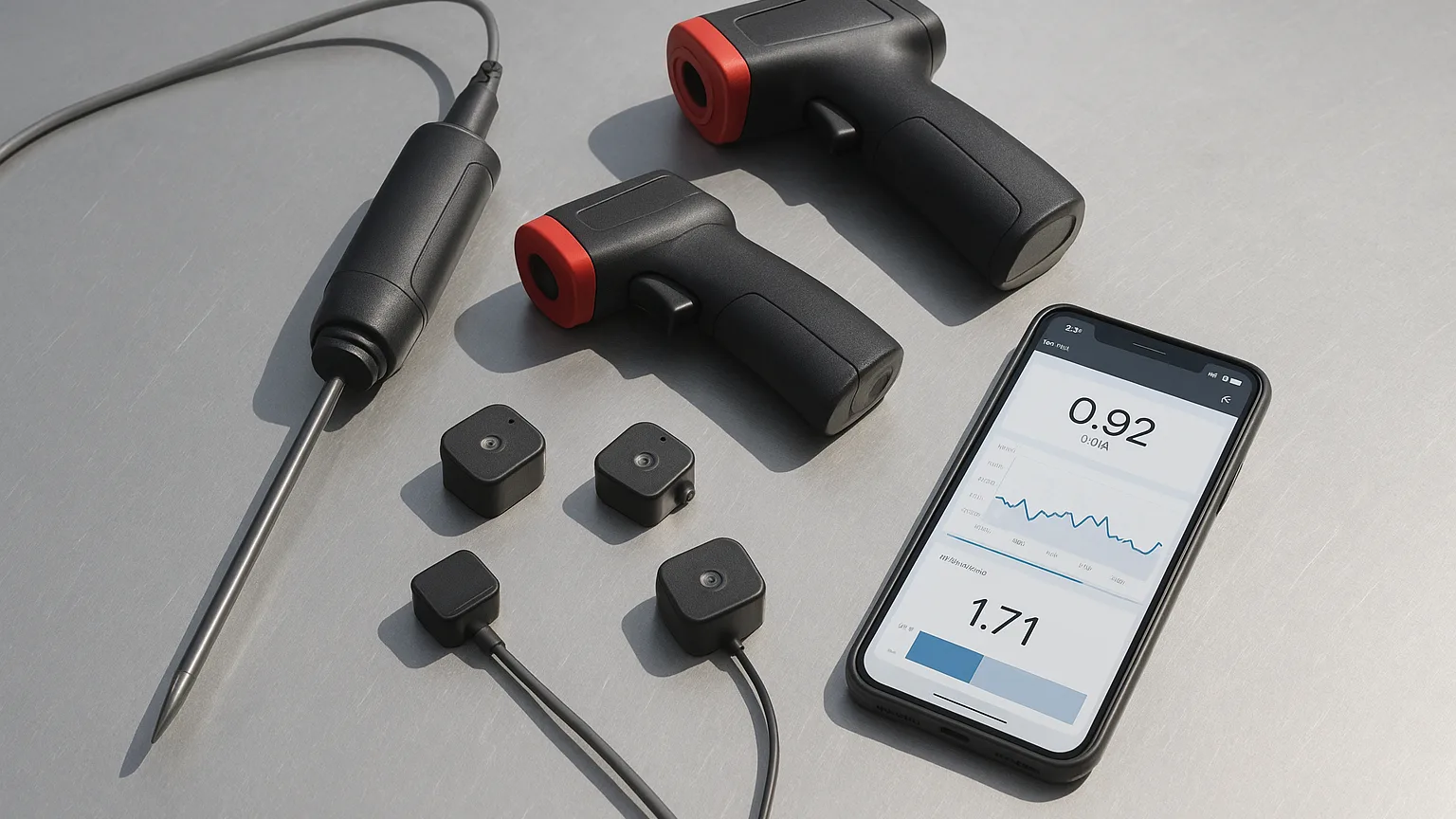
- Phones replaced laptops. Most affordable loggers now pair to a phone or tablet by Bluetooth. No harness surgery, no dedicated dash, no software licenses.
- Sensors got cheap and rugged. String pots, infrared tire sensors, and small accelerometers are now mass-produced for other industries. Racing just borrows them.
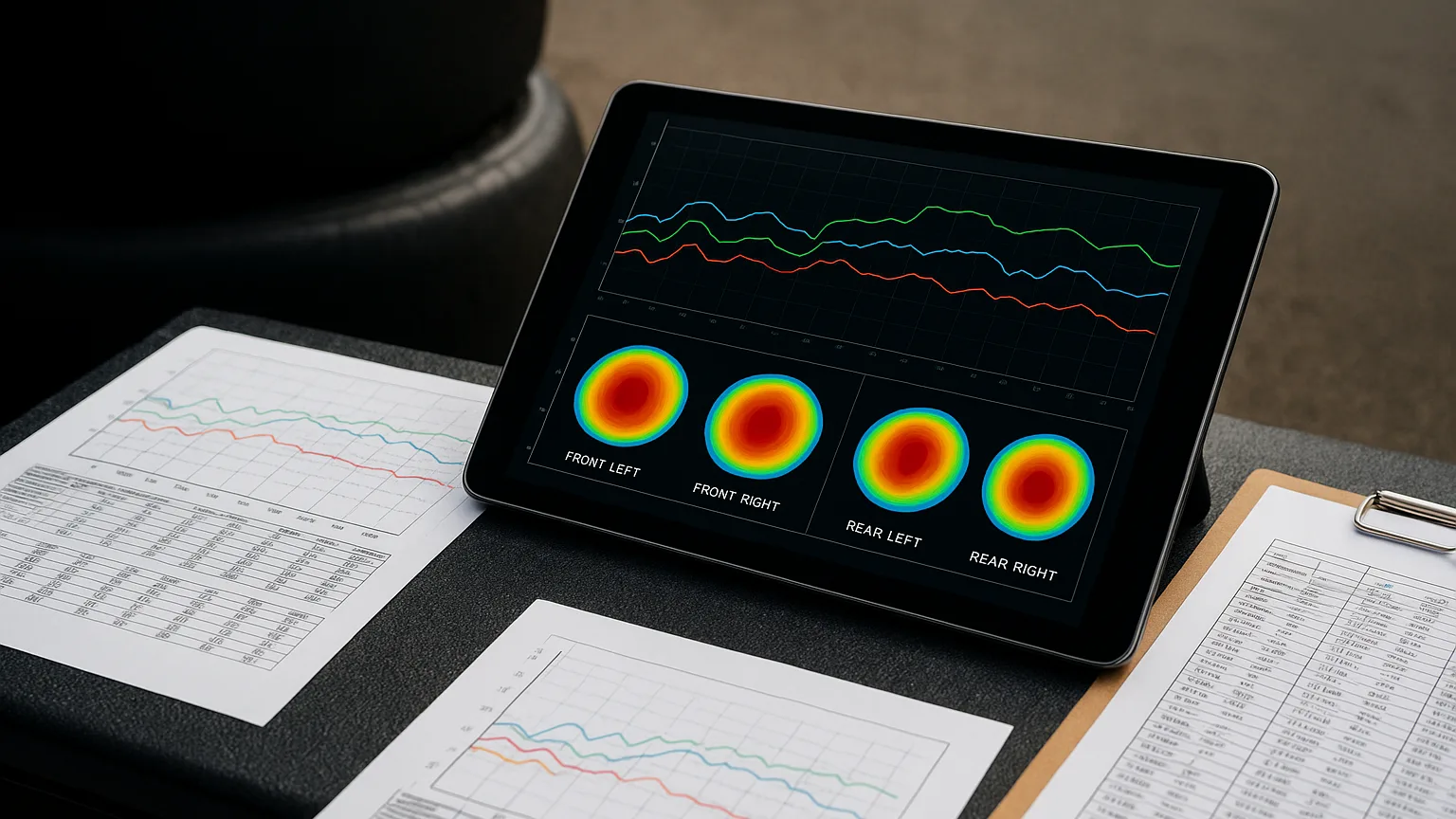
- The learning curve got shorter. App-based systems show you a shock trace or a tire temp spread in plain color and shape, not a spreadsheet you have to decode.
So the barrier is not money anymore, and it is not brains. It is habit. Plenty of good racers still trust the seat over the screen because that is how they were taught. The best ones now use both, and they stack tenths every week doing it.
The First Three Hundred Dollars Beats the Next Three Thousand
You do not need a full package. You need the one tool that answers the question you argue about most. For nearly everybody, that question is tires.
Start With a Tire Pyrometer
A probe-style pyrometer with memory is the highest-return tool in short-track racing. It tells you camber, pressure, and roll in one shot, three readings per tire, taken the same way every time.
Read across the tire: inside, middle, outside. If the inside edge is hot and the outside is cold, you have too much camber or too much roll. If the middle is the hot spot, you are over-inflated. If the whole right front is cooking while the right rear sleeps, the car is not sharing the work, and no amount of spring change fixes a tire that is already overloaded.
Then Add Shock Travel Sensors
Shock sensors are where the guessing really ends. A string pot on each corner shows you how far each shock moved, how fast, and where the car actually sat in the corner instead of where you think it sat.
Once you can see travel, you stop chasing feel and start solving geometry. You find out the left rear never came off the bump stop. You find out the right front bottomed halfway down the straight, which is why the car got tight entering. You find out your ride heights on the setup pad have almost nothing to do with your ride heights at speed.
Two channels is enough to start. Right front and right rear on an oval will teach you more in a night than a season of trailer debates.
Reading the Numbers Without an Engineering Degree
Data scares people because it looks like math. It is not math. It is shapes and gaps. You are looking for three things: what is different, what is repeating, and what does not match the story your body told you.
Compare, Do Not Judge
A single number means almost nothing. A right front tire at 190 degrees is neither good nor bad on its own. What matters is that it was 190 last week when the car was good and it is 215 tonight when the car is junk.
So build a baseline. Same track, same tire compound, same reading routine, written down every single time. Three nights of clean notes gives you something to measure against. That is the whole trick. The teams with the fancy trailers are not smarter than you, they just have four years of comparison and you have none. Start the file.
The Four Habits That Make Data Actually Work
- Read tires within 60 seconds of coming in. After that, the surface temp has bled off and the numbers lie to you. Assign one person the pyrometer and let them own the job.
- Change one thing at a time. If you change spring and stagger and pressure, the data tells you nothing about which one helped.
- Log the conditions, not just the car. Track temp, air temp, humidity, what the surface looked like, where the moisture was. Setup data without weather data is half a story.
- Write down what the driver felt, too. The goal is not replacing the seat. The goal is matching feel to numbers so the driver's language gets more precise.
What the Traces Are Telling You
Shock data has a rhythm to it. A trace that shoots up fast and comes back slow means the shock is soaking energy in one direction and holding it, which usually shows up as a car that will not roll back after the middle. A trace that never gets near full travel means you have more shock than you need and the car is riding on the spring alone.
Pair that with an accelerometer, which almost every phone-based logger includes, and you can see whether you are actually losing time in entry, middle, or exit. Most racers are wrong about where they lose time. They feel the corner that scared them, not the corner that cost them. The data does not care about scary.
This kind of clarity matters even more as classes standardize, because when sealed engines are taking over the setup sheet becomes the last place left to find real speed. When everyone runs the same power, the car that puts its tires to work wins.
Gates open Saturday nights in Pace, Florida. Check the schedule, grab your class rules, and get the car through tech the first time.
Data Compounds, Guessing Does Not
Data has a compounding effect that nothing else in racing has. A new motor makes you faster on the night you install it and no faster the week after. A shock sensor makes you faster every single week for the rest of your career, because the file keeps growing.
Miss a season and you do not just lose that season. You lose the head start it would have given the next three. The racer who starts logging in spring has 25 nights of comparison by fall. You have zero, and you are still asking your neighbor what he ran in the right rear.
The Real Cost of the Guessing Method
Do the honest arithmetic on a guessing season:
- Tires you cooked chasing a setup direction that was wrong from lap one.
- Hot lap sessions burned as experiments instead of confirmation.
- Parts you bought to solve a problem you never actually diagnosed.
- Nights you loaded early because the car never came in and nobody knew why.
Add it up. It is almost always more than the cost of the sensors. That is the uncomfortable truth of the modern budget program: measuring is now cheaper than replacing.
Build It in Three Steps, Not One Purchase
Nobody says spend it all at once. Spread it across the season and let each piece pay for the next.
Step one, this month. Memory pyrometer, a good notebook or a spreadsheet on your phone, and a tire pressure gauge you actually trust. Take readings every session for four weeks before you change anything.
Step two, mid-season. Two shock travel sensors and a small logger. Right side first. Match the traces to the tire temps you have already been collecting and watch the picture come together.
Step three, offseason. Fill in the left side, add a GPS or accelerometer channel, and go back through the whole year of files. That winter review is where the tenths hide, and it costs nothing but time. Do it in the same stretch you are already checking fuel system parts, since ethanol is coming gives you a natural reason to have the car apart anyway.
A Note on Overdoing It
There is a failure mode on the other side. Some racers buy 20 channels, drown in graphs, and never make a change because they are still analyzing. Do not be that guy either. Two channels you use every week beat twenty you look at once. The point of the tool is a decision, not a screenshot.
The Tenths Are Sitting Right There
Racing rewards the people who ask better questions. For decades the good questions were locked behind expensive hardware and expensive people, so most of us made peace with feel, guesswork, and the wisdom of whoever parked next to us. That wall came down quietly, one cheap sensor at a time, and a lot of Saturday-night programs have not noticed yet.
You do not have to become an engineer. You have to buy a pyrometer, take readings the same way every week, add a couple of shock sensors when you can, and write everything down. That is it. Do that, and by the end of the season you will stop arguing at the trailer and start pointing at a number. The racers who make that switch this year will spend the next one building on it. The ones who wait will be right back at the coin flip, hoping, while somebody with a $300 setup and a full notebook drives away from them into turn one.
Class rules, weekly payouts, and everything the pit gate needs before your first green flag.


